Adults who reported using cannabis had higher odds of reporting a past stroke or other cardiovascular disease than adults who did not, according to preliminary research presented at the American Heart Association’s Scientific Sessions 2026 in Chicago, November 6 to 9. The analysis pooled telephone survey answers from 442,906 U.S. adults in the Behavioral Risk Factor Surveillance System between 2020 and 2024. The strongest link was with stroke.
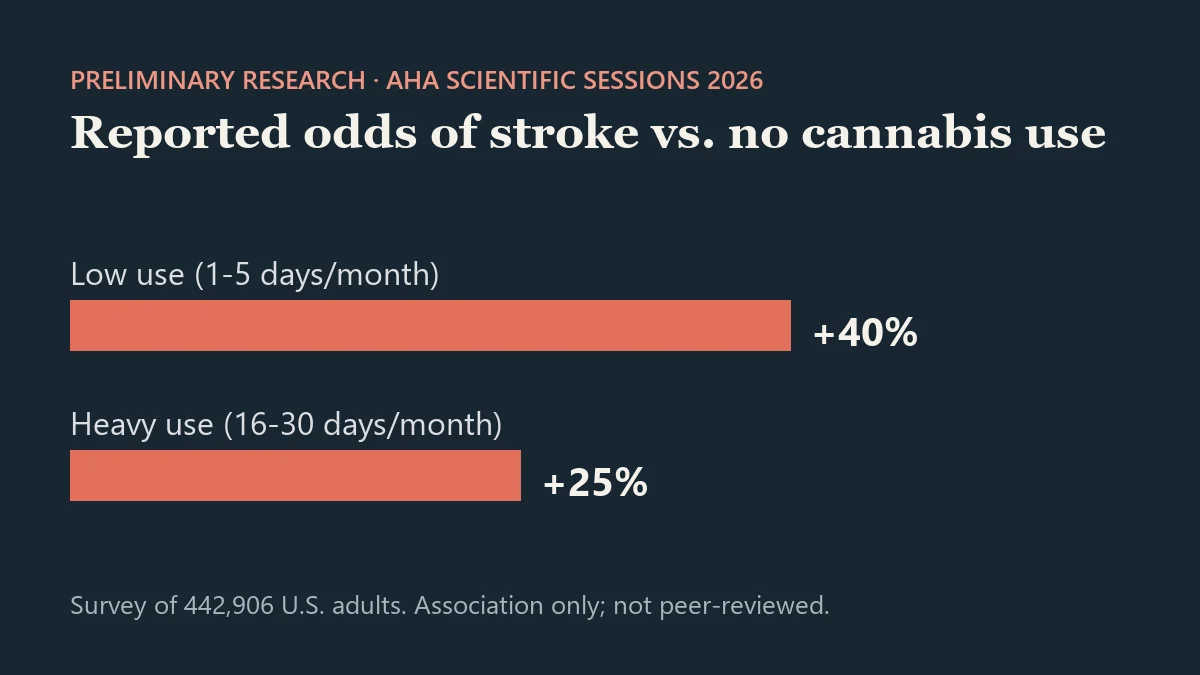
Compared with no use, cannabis use on 1 to 5 days a month was linked to 23% higher odds of reporting cardiovascular disease and 40% higher odds of reporting a stroke. Use on 16 to 30 days a month was linked to 21% and 25% higher odds. There was no statistically significant link with heart attack. The study cannot show that cannabis caused these outcomes.
What the Researchers Found
Lead author Aabha Divya of the Tulane University School of Medicine and colleagues grouped participants by how many days in the past month they used cannabis in any form, smoked, vaped or eaten: none, low (1 to 5 days), moderate (6 to 15) or heavy (16 to 30). The results were adjusted for demographics, tobacco smoking, alcohol, obesity, diabetes, chronic kidney disease, physical inactivity, education and income.
| Reported use vs. none | Any cardiovascular disease | Stroke |
|---|---|---|
| Low (1–5 days/month) | 23% higher odds | 40% higher odds |
| Heavy (16–30 days/month) | 21% higher odds | 25% higher odds |
The researchers said they were surprised the risk did not climb steadily with more frequent use. Both low and heavy use groups had higher odds.
Important Limits
- Not peer-reviewed yet. The AHA notes that abstracts presented at its meetings are considered preliminary until published in a peer-reviewed journal.
- Association, not cause. The survey captures one point in time, so it can’t show whether cannabis use came before the stroke.
- Self-reported. Both cannabis use and diagnoses were reported by participants, and people may have cut back after a diagnosis.
- No product details. The survey had no information on THC potency or amount used.
- Not every state. The cannabis questions are optional, and 16 to 24 states included them each year.
How It Fits With Earlier Research
The AHA release notes that earlier research from 2016 to 2020 also linked cannabis use to poorer cardiovascular outcomes. Robert L. Page II of the University of Colorado, who chaired the AHA’s 2020 cannabis scientific statement and was not involved in the study, said clinicians should ask about cannabis use the way they ask about tobacco when assessing heart risk.
What This Means for You
- If you have high blood pressure, heart disease or a history of stroke, tell your clinician if you use cannabis, including edibles.
- Older adults and people on several medicines have extra reasons to talk it through; see our older adults safety guide and medication interaction checklist.
- Dose matters for many cannabis effects; our THC dose-response explainer shows how.
Clear answers
Frequently Asked Questions
Does Cannabis Cause Strokes?
This study cannot show that. It found that adults who reported cannabis use had higher odds of reporting a past stroke, but it is a cross-sectional survey analysis and a preliminary, not-yet-peer-reviewed abstract.
How Much Higher Was the Stroke Risk?
Compared with no use, use on 1 to 5 days a month was linked to 40% higher odds of reporting a stroke, and use on 16 to 30 days a month to 25% higher odds.
Did the Study Find a Link With Heart Attacks?
No. The researchers did not find a statistically significant association between frequency of cannabis use and heart attack.
Does It Matter Whether Cannabis Is Smoked or Eaten?
According to the AHA release, the association was the same regardless of form, whether smoked, vaped or eaten.