Our verdict: Moose Labs offers a simple physical barrier for adults who choose to share smoking devices, and that is the product's strongest, most defensible benefit. Its 2018 event test found heavy surface contamination and lower readings when attendees used a MouthPeace. The public report leaves major questions unanswered, however, and its bacteria percentages should not be treated like a clinical finding.
Hygiene rationale: reasonable. Company study: useful but limited. Proof of fewer infections: absent. Proof of safer smoke or better lung health: absent. Best fit: adults who want a personal barrier during shared sessions and understand that it does not remove the health risks of inhaling smoke.
What the MouthPeace Is Designed to Do
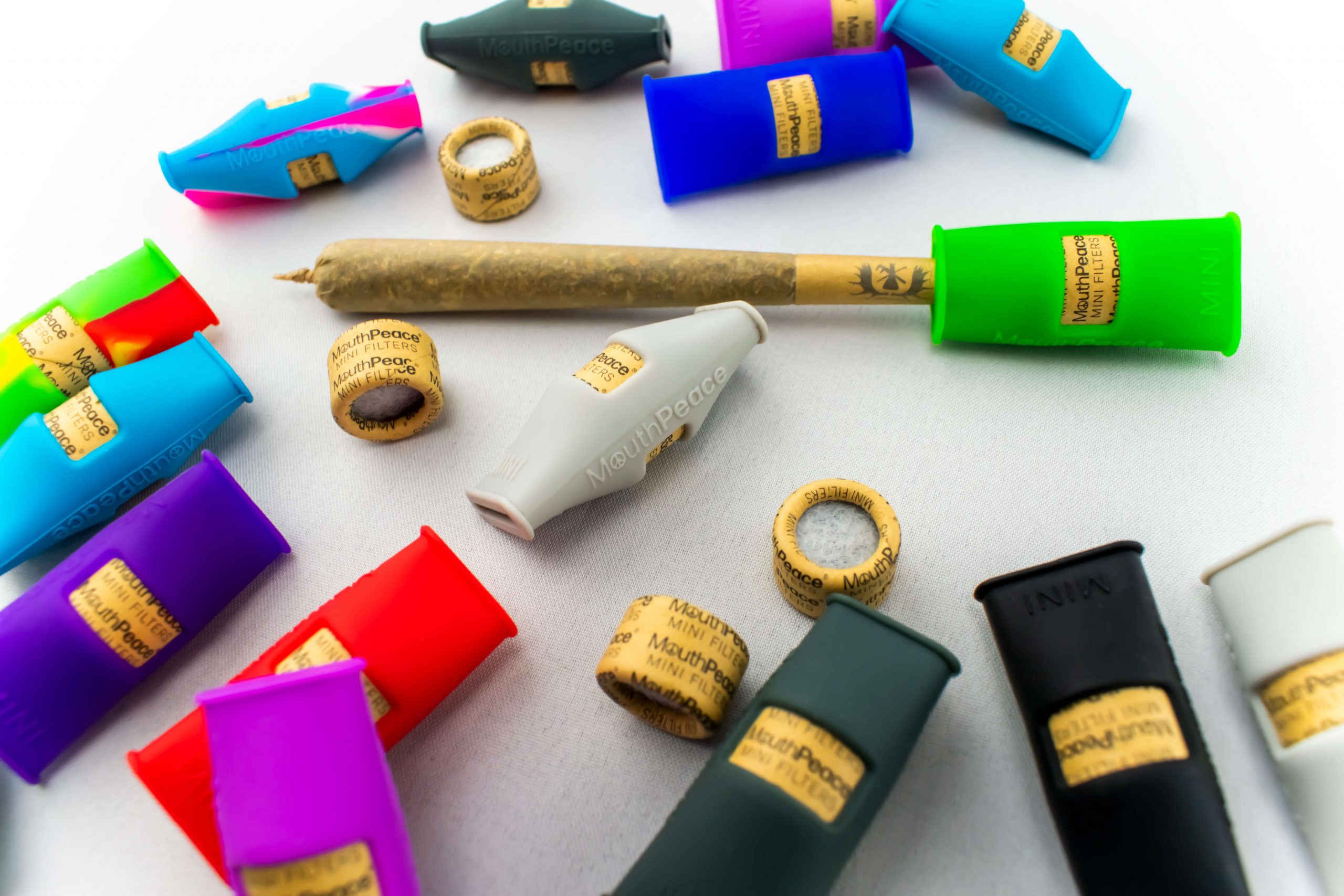
Moose Labs sells reusable silicone mouthpieces in sizes intended for pipes and water pipes, as well as smaller devices such as joints, pre-rolls and some vaporizers. Each person can use their own mouthpiece instead of placing their lips directly on a shared device. Optional replaceable filters add activated carbon or corn fiber, depending on the model and refill selected.
Those are two different product ideas. The silicone body is a contact barrier. The insert is a smoke filter. Evidence about residue on the outside of a shared pipe cannot automatically validate claims about what the filter removes from inhaled smoke or how that changes health risk.
How the Moose Labs Bacteria Study Worked
According to Moose Labs' study summary, testing took place at two social-consumption events in California. A total of 200 participants used a shared pipe. At each event, the first 50 were given a MouthPeace; the next 50 were not. Researchers swabbed the pipe's mouth area at predetermined intervals and read the samples with an ATP monitoring system.
The company also swabbed selected pipes, vaporizers and joints and compared those readings with public toilet seats, ATM buttons, shopping-cart handles, dog bowls, phone screens and other everyday surfaces. Moose Labs reported that the average cannabis pipe reading was 49% above a public toilet seat. Later coverage in the Aspen Times repeated that comparison and described the study as a 2018 project.
The Headline Results Need Careful Labels
Moose Labs says its sampled cannabis pipes averaged 49% more contamination than a public toilet seat, 92% more than an ATM keypad, 1,304% more than a dog-food bowl and 530% more than a phone screen. It also says only 5% of participants used available alcohol wipes.
Those figures are attention-grabbing, but the public page does not show the sample count for each comparison surface, the individual readings, uncertainty ranges, the ATP meter and swab protocol in enough detail to reproduce the result, or a statistical analysis. A toilet-seat comparison is memorable; without that supporting material, it is not a universal estimate of how every bong compares with every public restroom.
The company further states that MouthPeace use decreased bacterial spread and amount on the pipe by “more than 5924%.” That wording is mathematically unclear because an ordinary reduction cannot exceed 100%. It may be intended to describe how many times higher one group was than another, but the public summary does not supply the calculation. We would not repeat 5,924% as a verified reduction rate.
ATP Is a Cleanliness Signal, Not a Bacteria Count
ATP bioluminescence is a legitimate rapid hygiene-monitoring tool. It detects adenosine triphosphate associated with biological and organic residue and reports a relative-light-unit reading. That makes it useful for comparing surface cleanliness before and after an intervention.
It does not, by itself, identify bacteria or determine whether microbes are alive, pathogenic or capable of causing an infection. The CDC's environmental-cleaning toolkit explains that high readings can represent viable biological material, dead bacteria, organic debris or a mixture. A peer-reviewed comparison of ATP testing and microbial culture likewise found ATP useful for cleanliness monitoring but not a replacement for culture methods.
That distinction matters especially on a smoking device, where saliva, plant residue and resin can all contribute organic material. The study page calls the readings “bacteria,” but the stated method is better understood as measuring surface residue consistent with contamination.
What the Study Does Support
The test supports a narrow, commonsense conclusion: a heavily shared pipe can accumulate substantial biological residue, and putting a personal barrier between each mouth and the pipe can reduce direct contact. It also shows why relying on a quick wipe that few people use is not a complete shared-session protocol.
For someone who is going to share anyway, a personal mouthpiece is a practical harm-reduction accessory. The silicone barrier is visible, simple to understand and does not depend on every participant remembering to wipe the glass. That is a reasonable basis for considering the product even without treating the company's largest percentages as settled science.
What the Study Does Not Establish
- No pathogen identification: the public report does not name the organisms present or show culture or sequencing results.
- No infection outcome: it does not show whether participants became ill or whether MouthPeace users had fewer infections.
- No clear randomization: giving the first 50 people a MouthPeace and the next 50 no instruction creates a possible order effect as a shared pipe becomes dirtier over time.
- No independent replication: the public page does not identify an outside laboratory or a peer-reviewed replication.
- No smoke-chemistry test: the bacteria study did not measure tar, carbon monoxide, fine particles, cannabinoids or other compounds before and after a filter.
- No lung-health endpoint: it did not measure coughing, airway irritation, respiratory symptoms or long-term disease.
“Cleaner Smoke” Is Not the Same as Safe Smoke
A used filter may visibly collect dark residue, and some consumers may perceive a smoother draw. Neither observation proves that the remaining smoke is harmless or that clinically meaningful exposure has fallen. The amount and identity of each constituent removed, along with what still passes through, would require controlled aerosol chemistry and exposure testing.
The CDC's cannabis and lung-health guidance says smoked cannabis can harm lung tissue regardless of how it is smoked and contains many of the same toxins, irritants and carcinogens as tobacco smoke. A MouthPeace should therefore be described as a hygiene barrier with an optional filter, not as a device that makes smoking safe.
Who Should Consider It and Who Should Skip It
Consider it if you are an adult who already uses compatible smoking devices, regularly shares them, wants a personal mouth-contact barrier, and accepts the ongoing cost of replacement filters. The Mini format may make more sense for joints, pre-rolls and compatible vapes; the Original is intended for larger glass pieces.
Skip it if you expect medical-grade infection protection, believe it eliminates the pulmonary risks of smoke, or do not want to replace filters. Someone who uses a device alone and cleans it consistently may get less value from the sharing barrier.
Do not share a smoking or vaping device when someone is sick. A mouthpiece does not stop close-range respiratory exposure, contamination from hands, or contact with unclean parts of the device. Clean the reusable silicone component according to the maker's instructions and replace filters as directed.
Moose Labs lists MouthPeace Original, Mini and Micro sizes plus activated-carbon and corn-fiber refills. Confirm that the mouthpiece and filter size match your device, and check current kit contents, price and shipping terms on the live product page.
Final Verdict
Moose Labs has a good product concept wrapped in marketing that runs ahead of the public evidence. A personal mouthpiece is a sensible way to avoid direct lip contact with shared glass, and the company's event test is consistent with that hygiene benefit. The study's design and reporting are not strong enough to turn the exact comparison percentages into universal facts.
The fairest recommendation is narrow: buy it for the barrier and convenience if those solve a real problem in your sessions. Treat filtration and “cleaner smoke” as product claims that still need stronger independent testing, and do not treat the MouthPeace as permission to ignore cleaning or the respiratory risks of cannabis smoke.
Clear answers
Frequently Asked Questions
Was the Moose Labs Bacteria Study Peer Reviewed?
The public study page does not identify a peer-reviewed journal publication, independent laboratory, named researchers, raw data table or statistical analysis. It is best treated as company-run product research.
Does the Study Prove MouthPeace Makes Cannabis Smoke Safer?
No. The study measured ATP on shared-device surfaces. It did not measure smoke chemistry, lung exposure, infection rates or long-term health outcomes.
What Does an ATP Surface Test Measure?
ATP bioluminescence is a rapid indicator of biological and organic residue. It does not by itself identify bacteria, determine whether microbes are alive, identify pathogens or measure infection risk.
Who May Find a MouthPeace Useful?
Adults who choose to share compatible pipes, joints or vaporizers may value a personal silicone barrier and optional replaceable filter. It should supplement, not replace, cleaning and avoiding shared devices when someone is ill.