A carefully controlled combination of THC and CBD reduced agitation in people with advanced dementia who were receiving or eligible for hospice care, according to the official topline results from the LiBBY trial. The finding is more rigorous than the small and mixed studies that previously shaped this conversation. It is not evidence that a retail CBD oil, gummy, tincture, or dispensary product will produce the same result.
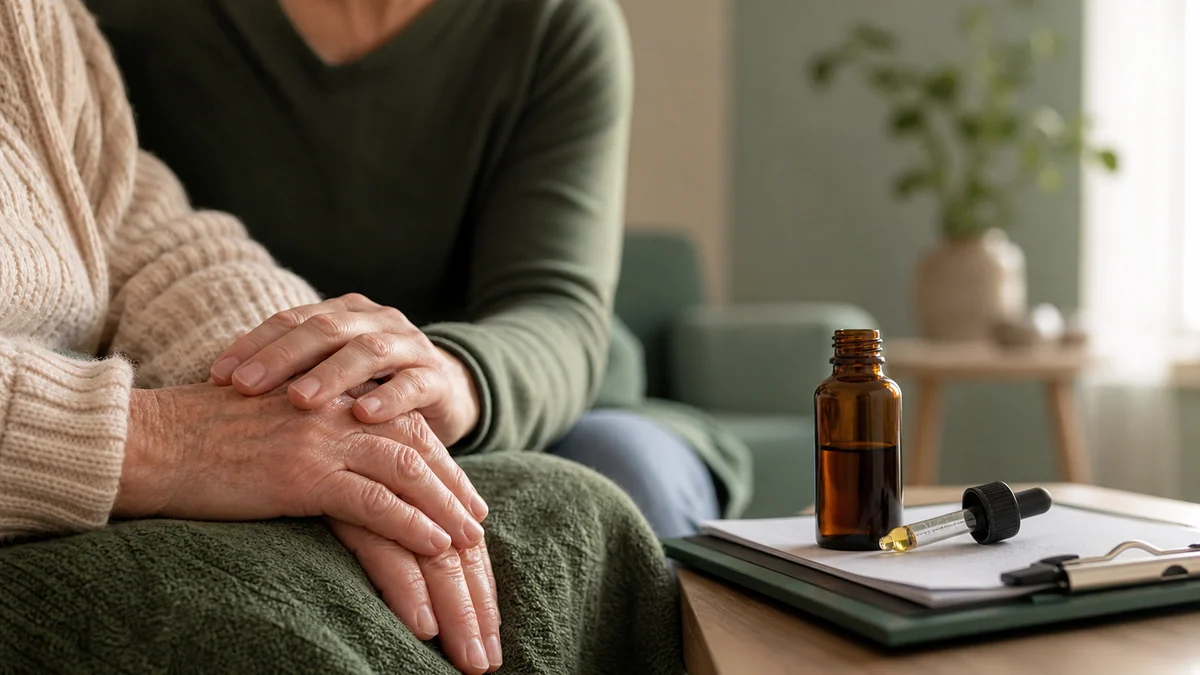
The trial was multicenter, double-blind, randomized, and placebo-controlled. It met its primary and key secondary endpoints. The results are currently available as conference slides and a topline announcement, not a complete peer-reviewed journal article with all prespecified analyses and methodological details.
What the LiBBY Trial Tested
LiBBY—short for Life's End Benefits of cannaBidiol and tetrahYdrocannabinol—was a U.S. Phase 2 study funded primarily by the National Institute on Aging and conducted through the NIH-funded Alzheimer's Clinical Trial Consortium. It enrolled people age 40 or older with major neurocognitive disorder, clinically significant agitation, and advanced illness based on hospice enrollment, dementia staging, or a prognostic score.
The study drug, called T2:C100, was not a general category of “medical marijuana.” One milliliter contained 2 mg of THC and 100 mg of CBD in an oral digestible oil. During the first week, participants received 1 mL twice daily: 4 mg THC and 200 mg CBD per day. From week 2 through week 12, the dose increased to 2 mL twice daily: 8 mg THC and 400 mg CBD per day.
That detail is central to reading the result. The product was purified, manufactured for research, delivered on a fixed schedule, and used with clinical oversight in an end-of-life population. The study team says it is not publicly available and that the findings do not apply to other THC/CBD formulations or recreational marijuana.
The Main Findings
| Outcome | What LiBBY reported | How to read it |
|---|---|---|
| Agitation at week 2 | The treatment group had a 6.27-point greater reduction than placebo on the Cohen-Mansfield Agitation Inventory, with a 95% confidence interval from 2.87 to 9.66 points favoring treatment. | This was the prespecified primary endpoint and was statistically significant. |
| Agitation through week 12 | The modeled average difference between groups was 8.23 points favoring T2:C100, with a 95% confidence interval from 4.86 to 11.6 points. | The benefit was sustained in the trial's key secondary analysis. |
| Clinician-rated improvement | At week 2, 83.9% improved with T2:C100 versus 30.5% with placebo. At week 12, the comparison was 87.2% versus 23.6%. | The large separation supports the agitation-scale result, but “improved” is not the same as cured or free of symptoms. |
| Open-label extension | Participants initially assigned placebo improved after switching to T2:C100, while early-start participants continued to improve, according to the extension presentation. | Everyone knew they were receiving the drug, so the extension supports durability but cannot provide the same causal certainty as the blinded phase. |
Why This Result Matters
Agitation in advanced dementia may include pacing, repetitive vocalization, emotional distress, verbal hostility, or physical aggression. It can also signal pain, fear, infection, constipation, medication effects, overstimulation, or another unmet need that a person can no longer explain. For patients and caregivers, the clinical goal is not simply less visible movement. It is less distress, greater comfort, and safer, more humane care.
Earlier cannabinoid studies in dementia were generally small and used different products, doses, populations, and outcomes. CannaWize's broader dementia-agitation evidence review concluded that there was a signal worth studying but too little consistent evidence for broad claims. LiBBY materially strengthens that signal because it randomized 120 participants, used placebo control, included multiple U.S. sites, and reported consistent results across its primary outcome, key secondary outcomes, sensitivity analyses, and prespecified subgroups.
The trial also matters methodologically. People with late-stage dementia and hospice-level needs are often excluded from clinical research even when the unanswered question directly affects their care. LiBBY reported that 58% of participants came from underrepresented ethnoracial groups and 75% lived in community settings, showing that a more representative advanced-dementia trial was feasible.
The Safety Data Need More Than One Sentence
The overall proportion experiencing at least one adverse event was similar: 46.7% with T2:C100 and 42.4% with placebo during the 12-week blinded phase. The serious-event numbers were less balanced. Fourteen treated participants, or 23.3%, experienced at least one serious adverse event, compared with seven placebo participants, or 11.9%.
Deaths were also numerically higher during the blinded phase: eight of 61 participants assigned T2:C100 died, compared with three of 59 assigned placebo. The investigators reported no pattern among the causes and judged none related to the investigational product. In a hospice-eligible population with advanced dementia, deaths and serious illnesses are expected. That context is essential—but it does not make the imbalance disappear. A 120-person Phase 2 trial is too small to rule out uncommon harms or confidently separate chance, underlying illness, and treatment effects.
By week 12, 16 people in the treatment group had discontinued, compared with six in the placebo group. Death accounted for much of that difference; unwillingness or inability to continue also occurred more often with treatment. The published slides report one adverse-event discontinuation in each arm.
In the voluntary 12-week open-label extension, 93 participants started T2:C100 and 85 completed. Serious adverse events occurred in seven of 43 early-start participants and three of 50 delayed-start participants. Deaths were similar in those two extension groups, three versus three, and the team reported no significant new safety concern. Because the extension had no placebo group and enrolled survivors willing to continue, it is supportive—not definitive—safety evidence.
What “Nearly 9 in 10 Improved” Does—and Does Not—Mean
The 87.2% figure refers to clinician-rated global improvement among treated participants at week 12. It is an encouraging outcome, especially beside 23.6% on placebo. It does not mean 87.2% became agitation-free, regained cognition, extended life, or experienced the same magnitude of benefit.
LiBBY was designed to treat a symptom, not the underlying disease. Nothing in the topline results shows that THC or CBD slowed Alzheimer's progression or reversed dementia. Nor can the result show whether a different ratio, a lower-cost retail product, or occasional dosing would work. Product identity is not a technical footnote here; it defines the evidence.
Conference Results Are an Important First Report, Not the Final Word
The double-blind findings were presented at the Alzheimer's Association International Conference on July 14, 2026, and the open-label extension followed on July 15. The public double-blind results deck supplies randomization counts, outcome models, confidence intervals, adverse events, discontinuations, and participant characteristics. That is substantially more informative than a bare press release.
A full peer-reviewed publication is still needed. It should allow readers to evaluate the protocol and statistical analysis plan against the final report, see complete secondary and subgroup results, understand missing-data handling, review individual adverse-event narratives, and judge whether agitation improvement came with changes in alertness, pain, sleepiness, caregiver burden, or other daily outcomes.
The study team says it plans a larger trial in a broader population. Replication matters because one positive Phase 2 trial can establish a promising direction, but approval, routine clinical use, comparative value, and uncommon risks require more evidence.
What Caregivers Should Take From the Study Now
- Do not substitute a store product for the study drug. T2:C100 is a high-CBD, low-THC purified formulation with an exact dose and delivery system. Consumer products also carry the quality and labeling limits explained in CannaWize's CBD safety myth check.
- Treat new agitation as information. Pain, infection, urinary retention, constipation, dehydration, medication changes, sleep disruption, and environmental stress may require attention.
- Start with non-drug approaches when appropriate. The Alzheimer's Association continues to recommend environmental changes, structured routines, and psychosocial strategies as first-line care.
- Use a clinician-led goal. A plan should define the target symptom, expected benefit, monitoring for sedation or falls, medication interactions, and a stop rule if benefit does not appear.
- Do not change hospice or dementia medication from a headline. Advanced illness changes the balance of comfort, alertness, risk, and family priorities; that decision belongs in shared care planning. Our patient information guide offers questions to bring to a clinician.
The Bottom Line
LiBBY is a genuinely encouraging trial. A specific oral THC/CBD formulation reduced agitation more than placebo within two weeks, and the benefit persisted through 12 weeks in people with advanced dementia and hospice-level needs. The size and consistency of the efficacy signal make a larger confirmatory trial worthwhile.
The responsible headline has a second half. These are topline conference results for one investigational product. Serious adverse events, deaths, and discontinuations were numerically higher in the treatment arm during the blinded phase, even though investigators found no causal pattern. LiBBY supports further clinical development and careful discussion. It does not turn consumer cannabis into a proven dementia treatment.
Clear answers
Frequently Asked Questions
What did the LiBBY study find?
In a 120-person randomized Phase 2 trial, a specific oral THC/CBD formulation reduced agitation scores more than placebo at two weeks, and the difference was sustained through 12 weeks.
Can the LiBBY results be applied to dispensary cannabis or retail CBD oil?
No. The trial tested a purified investigational formulation with a specific THC-to-CBD ratio, dose, schedule, and delivery system. The investigators state that the findings do not establish the safety or efficacy of other cannabis products.
Was the LiBBY THC/CBD formulation proven safe?
Overall adverse-event rates were similar, but serious adverse events, deaths, and discontinuations were numerically higher in the treatment arm during the blinded phase. Investigators judged none of the serious events or deaths related to the study drug, but the imbalance needs attention in larger trials.