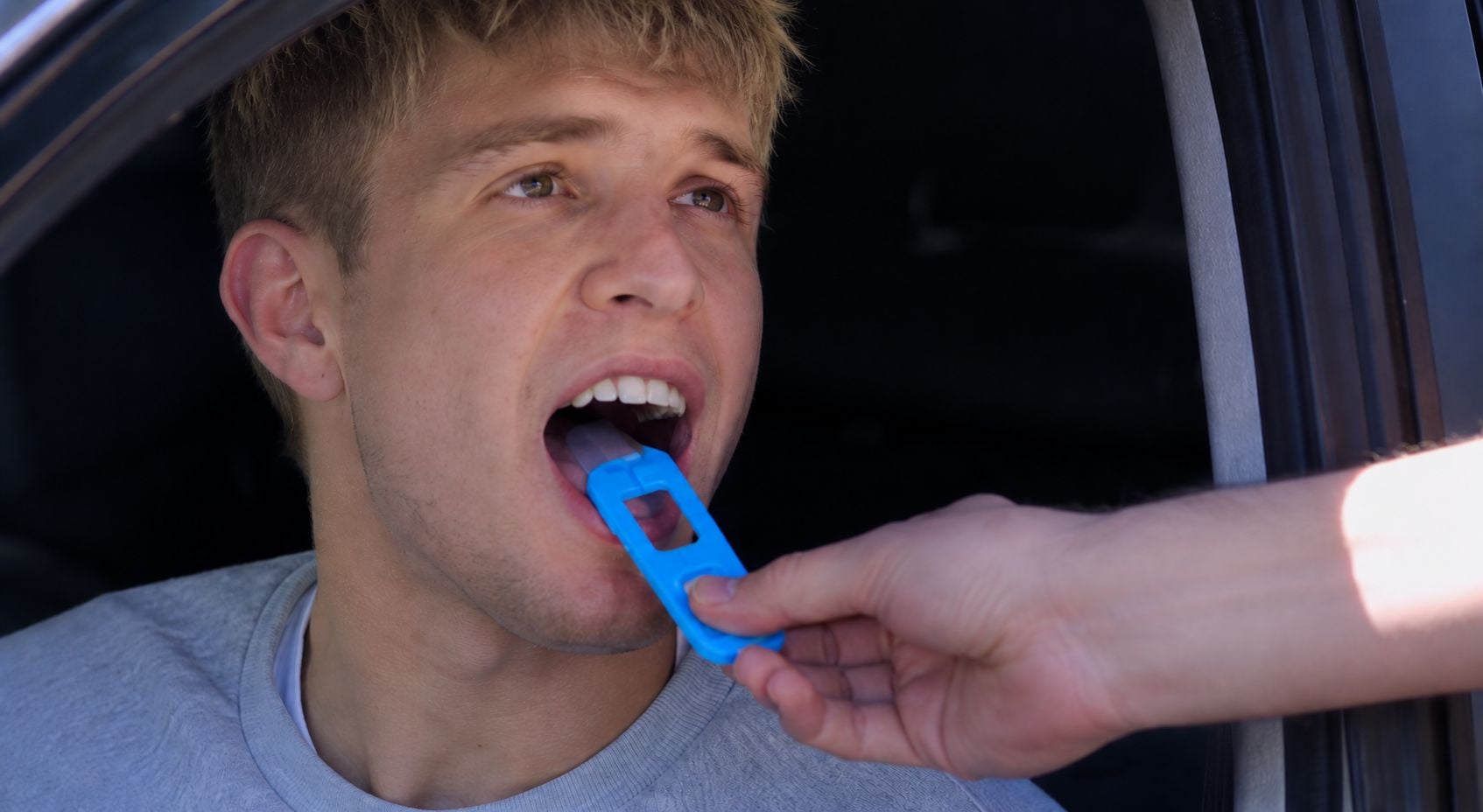
Blood draws and lab-only confirmation have long made THC-impaired driving cases slow and expensive to build. A new U.S. Department of Transportation report summarizes National Highway Traffic Safety Administration information on state oral fluid, or “spit,” testing programs in five states, and it points to New York as proof that evidentiary oral fluid testing for THC can work at scale, not just in a small pilot.
The DOT report covers oral fluid roadside drug-testing programs in Alabama, Indiana, Kansas, New York, and Washington. New York is described as the most successful example: a large, heavily populated state that moved from a pilot to a statewide program, with faster investigations, less reliance on hospital blood draws, and no successful court challenge to the evidence so far.
Five States, One Question: Does Spit Testing Scale?
Oral fluid testing lets an officer collect a saliva sample roadside, rather than transporting a driver to a hospital for a blood draw. The DOT report reviews how Alabama, Indiana, Kansas, New York, and Washington have each built oral fluid programs into their drug-impaired driving enforcement, with NHTSA data behind the comparison. The core question the report addresses is whether a program built around a small or mid-sized state can also work somewhere with far more agencies, more drivers, and more courtrooms to convince. New York is the test case, and the report treats its results as the strongest evidence yet that it can.
New York's Rollout: Pilot to Statewide Program
New York ran a pilot program before taking oral fluid testing statewide in July 2024. It is now a standalone option available to law enforcement investigating non-injury misdemeanor drugged-driving cases, meaning officers do not need to fall back on a hospital blood draw as the default path to build a case.
Adoption has grown steadily since the statewide rollout. As of July 2025, oral fluid samples accounted for 30% of the state's drug-related lab submissions, with roughly 20 non-State Police agencies participating alongside the State Police itself. That is a meaningful share of casework moving to a faster collection method within about a year of statewide availability.
Why Agencies Say It Is Faster and Cheaper
The report notes that law enforcement agencies reported faster investigations and reduced reliance on hospital-based blood draws. That matters beyond convenience. A hospital blood draw requires transporting the driver, waiting for a phlebotomist, and, later, that phlebotomist may need to testify in court about how the sample was collected. Oral fluid collection at the roadside removes that chain, saving both time and the cost of coordinating hospital staff and court testimony tied to the draw itself.
The Legal Test: No Trials Yet, but No Losses Either
Evidentiary value is only real if it holds up in court, and this is where New York's early record is notable. As of the report, no trial has yet turned on oral fluid test results. But the evidence has already faced its first legal test: two hearings were requested specifically to determine whether oral fluid results should be admissible. Judges denied both requests, meaning the evidence was allowed to be used rather than excluded. It is a small sample, but it is an early signal that the science and chain-of-custody procedures behind New York's program are holding up under scrutiny before a single case has gone to trial.
What This Means Outside New York
For the other four states in the report, and for any state watching from the outside, New York's results reframe oral fluid testing as more than a niche pilot tool. A state with dozens of participating agencies and a meaningful share of lab submissions moving to oral fluid samples is a different proposition than a small pilot county. States considering their own programs now have a large-state precedent to point to, both operationally and in terms of what has happened, so far, in the courtroom.
What the Report Does Not Settle
The report is a program summary, not a clinical or legal final word. It does not establish a dose-response relationship between oral fluid THC concentration and actual impairment, and two denied admissibility hearings are not the same as a body of appellate case law. Oral fluid testing tells law enforcement whether THC or another drug is present in a sample; it does not, on its own, measure how impaired a driver was at the moment they were stopped. Readers should treat New York's early numbers as a promising operational and legal track record, not a settled science of THC impairment measurement.
Clear answers
Frequently Asked Questions
What Does the DOT Report Cover?
It summarizes National Highway Traffic Safety Administration information on oral fluid (spit) testing programs used for roadside screening of drug-impaired driving, including THC, in five states: Alabama, Indiana, Kansas, New York, and Washington.
Why Does the Report Single Out New York?
New York is the largest, most heavily populated state among the five, and the report treats it as evidence that evidentiary oral fluid testing for THC can scale successfully beyond a small pilot into a statewide law enforcement tool.
Has Oral Fluid THC Evidence Been Challenged in Court?
As of the report, no New York trial has involved oral fluid results yet. Two hearings requested to determine the admissibility of the evidence were both denied by judges, which allowed oral fluid evidence to be used rather than excluding it.